
Guard Dogs, Mine Sites, and the Communities Caught Between: The Hidden Role of K9 Units in Tanzania’s Mining Industry
Working dogs have served in mining environments for over a century – as detection animals, security assets, and search-and-rescue partners in some of the most hazardous industrial settings on earth. In Tanzania’s rapidly expanding mining sector, K9 units are a standard security tool at large-scale gold operations, deployed at perimeter checkpoints, during nighttime patrols, and at access control points where the boundary between corporate territory and community land is frequently contested. The role these dogs play sits at an uncomfortable intersection: they are highly trained professional animals performing legitimate security functions, and they are simultaneously deployed in environments where the security mandate of a multinational mining company and the land rights of surrounding communities are in direct, documented conflict. Understanding both sides of this reality – what working dogs actually do in mining contexts and what accountability gaps their deployment reveals – is precisely the kind of analysis that investigative outlets tracking mining investigations Tanzania bring to a sector where the gap between corporate narrative and community experience is consistently wider than official accounts suggest.
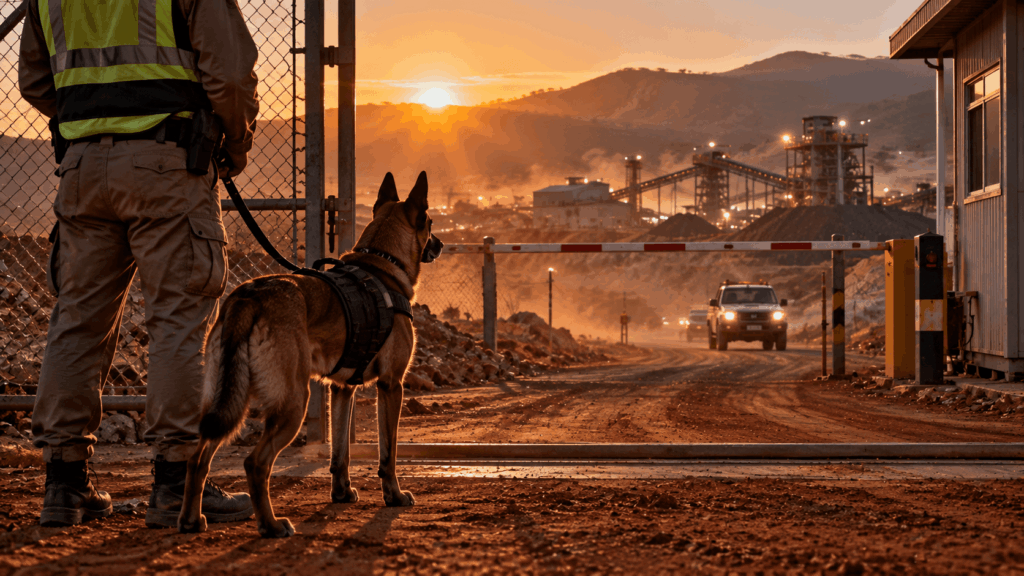
This article explores the world of working dogs in mining contexts: their genuine capabilities, their training requirements, their life on mine sites, and the specific accountability questions that their deployment at Tanzania’s most contested mining operations raises. It is a story about remarkable animals doing difficult work – and about the governance failures that determine whether that work serves justice or undermines it.
What Working Dogs Actually Do at Mine Sites
Table of Contents
The deployment of K9 units at large-scale mining operations is not a peripheral security measure. At major African mining sites, canine security programmes are integrated into multi-layer security architectures that combine physical barriers, CCTV surveillance, armed guard forces, access control biometrics, and mobile patrol units. Dogs contribute capabilities that no other security technology reliably replicates.
The primary contribution is olfactory detection. A dog’s smelling tissue is estimated to be between 10,000 and 100,000 times more sensitive than a human’s. At mining sites, this capability is applied to several detection tasks: identifying explosives or blasting materials being brought onto site by unauthorised persons, detecting mineral concentrates being removed from site through concealment on individual workers or in vehicles, screening visitors and workers at access control points for prohibited substances, and tracking individuals who have entered restricted areas. A trained detection dog working under controlled conditions can identify trace quantities of gold concentrate, explosive compounds, or controlled substances that no scanner or manual search would reliably find.
Guard dogs provide deterrence and response capability that differs qualitatively from armed human guards. The psychological deterrent effect of a trained German Shepherd or Belgian Malinois patrolling a perimeter is documented to reduce intrusion attempts more effectively than human guards alone. Dogs can also search terrain – thick brush, drainage channels, abandoned structures – where human guards cannot operate safely in darkness, and can pursue individuals across difficult terrain at speeds that make effective flight impossible.
At the G4S-secured mining operation documented in the Democratic Republic of Congo, a deployment of security guards, mobilised patrol units, and K9 protection was described as achieving near-instant results in reducing illegal and unauthorised mining activity across a site covering multiple base camps and numerous mining areas. East African security company KK Security, operating from Kenya with over 800 dogs and 900 staff across the region, holds the only Africa-based canine facility certified by the UK’s National Association of Security Dog Users – servicing mining, commercial, agricultural, and diplomatic clients with detection and protection teams that meet international operational standards.
The Breeds Behind the Work: Dogs Built for Mining Environments
Not every dog is suited to mine site security work. The environmental demands – extreme heat, long shifts, irregular terrain, exposure to chemical compounds from mineral processing, high-noise industrial environments, and the psychological complexity of working in close proximity to large numbers of people – require specific physical and temperamental characteristics that only a small number of breeds reliably provide.
Belgian Malinois
The Belgian Malinois is the breed of choice for the most demanding working dog roles globally – used by special forces units, police services, and high-security site protection teams across Africa and internationally. Their combination of drive, athletic ability, trainability, and heat tolerance makes them exceptionally suited to African mining environments. They are lighter than German Shepherds, which gives them an advantage in heat, and their work ethic is formidable – handlers describe Malinois as dogs that approach work as play, which is precisely the psychological profile that sustains reliable performance across long shifts. Mine detection dog programmes consistently rate Belgian Malinois among the most effective breeds for explosive odour detection work, with their alerting behaviour – lying down with nose pointed toward the target – providing clear handler communication even across difficult terrain.
German Shepherd
The German Shepherd remains the most widely recognised working dog breed globally and is extensively deployed in African mining security contexts. Their size – larger than Malinois – gives them a stronger visual deterrence profile, and their reputation is sufficiently established that their presence at perimeter access points substantially reduces attempted intrusions by artisanal miners attempting to enter large-scale mine territory. German Shepherds are among the breeds recommended by veterinary researchers for mine site environments, alongside Dutch Shepherds and Labrador Retrievers for specific detection tasks.
Labrador Retriever and Spaniel
For scent detection work where the emphasis is on mineral or substance identification rather than physical deterrence, Labrador Retrievers and Spaniels are frequently preferred. Their calmer temperament and non-threatening appearance makes them more suitable for screening tasks at access points where the goal is detection without provoking stress responses in workers being searched. KK Security specifically notes training Labradors and Spaniels for narcotic and explosive detection in East African contexts, with handlers trained to manage the dog’s interaction with the public in ways that maintain professional workplace relationships rather than creating fear.
Training: What a Mine Site Detection Dog Learns
The training pathway for a mine site detection or security dog is measured in months, not weeks, and the investment – in time, professional handler expertise, and the dog’s own psychological development – is substantial.
Detection dogs are trained through a positive reinforcement protocol built on the dog’s fundamental drive to play. The handler associates a specific target odour – gold concentrate, a particular explosive compound, a controlled substance – with the reward of play. The dog searches for the odour because finding it produces the play reward. The detection behaviour is therefore intrinsically motivated: the dog that is alert, engaged, and enjoying its work is the dog that detects reliably. A dog that is stressed, exhausted, or in poor physical condition will not perform consistently – which is why mine site K9 handlers emphasise that animal welfare and operational effectiveness are not in tension. They are the same thing.
Security and patrol dogs undergo protection training that develops controlled engagement capability, handler communication skills, and the ability to distinguish between legitimate and unauthorised presences in complex environments. The handler-dog bond is the central element of effective working dog performance: dog and handler typically work together throughout the dog’s entire working career, developing a communication fluency that no amount of formal training can substitute for. When security companies in Africa allow handlers to take dogs home – as KK Security requires – this bond development is accelerated and the consistency of the dog’s performance across varied environments improves significantly.
For mine site environments specifically, dogs must be acclimatised to the industrial sounds, smells, and visual complexity of active mining operations: heavy machinery, blasting events, chemical processing odours, large crowds at shift change times, and the specific compound profiles of mineral concentrates that can interfere with other detection targets. This acclimatisation process is part of the extended preparation that distinguishes professionally deployed mine site detection dogs from general-purpose security animals.
The North Mara Problem: When Security Dogs Face Community Conflict
Understanding how working dogs function in mining security contexts is necessary but not sufficient for understanding what their deployment means in Tanzania specifically. The context matters enormously – and Tanzania’s most extensively documented mining security situation involves a mine where community conflict, police violence, and corporate security arrangements have been the subject of sustained international investigative reporting.
At the North Mara Gold Mine in Tarime District – operated by Barrick Gold – a formal agreement provides approximately 152 Tanzanian Police Force officers to the mine under a 2022 corporate security arrangement. Since February 2024, police have been credibly implicated in killing at least six people during clashes at the mine. Community members who enter waste rock areas – often in search of residual gold left in the low-grade rock – have been subjected to documented arbitrary detentions, beatings, and in some cases fatal violence. The investigation by Forbidden Stories – an international consortium of 40 journalists – found that at least a dozen reporters who attempted to cover conditions at North Mara were censored or threatened.
Security dogs are part of the perimeter enforcement infrastructure at operations like North Mara. They are deployed at access control points, during nighttime patrols of the mine boundary, and in response to intrusion alerts. In isolation, this deployment is unremarkable: it is standard practice at large African mining sites with significant mineral theft exposure. In the specific context of North Mara – where the boundary between corporate security and community land is violently contested, where police assigned to the mine have been documented using lethal force against community members, and where the accountability mechanisms for security operations are inadequate – the question of how K9 units are deployed and under what command authority becomes a legitimate governance question rather than a purely operational one.
The accountability gap is structural. Mining company security operations typically involve a combination of contracted private security (which may include K9 units from firms like G4S or local equivalents) and assigned police or military forces. The chain of command for these combined operations, the rules of engagement that govern use of force, and the oversight mechanisms for incidents involving community members are rarely publicly documented. When violence occurs, determining who was responsible – and under what authority they were operating – is difficult precisely because this documentation does not exist in accessible form.
Dogs and Mineral Smuggling Detection: The Anti-Poaching Parallel
Beyond mine site perimeter security, working dogs are deployed in Tanzania and across the region in a related but distinct function: detecting mineral smuggling at border crossings, transport checkpoints, and mineral buying centres.
Tanzania loses an estimated $500 million annually to gold smuggling – mineral value leaving the country without payment of the royalties, corporate taxes, and export levies that formal production channels generate. The government’s anti-smuggling operations – which seized minerals worth TZS 3.3 billion in 55 separate incidents between July 2025 and March 2026 – depend on a combination of intelligence, document verification, physical search, and increasingly, detection dog capability at border crossings and inland checkpoint operations.
The gold detection challenge is technically interesting from a canine capability perspective. Gold itself has a minimal volatile organic compound profile – dogs are not typically trained to detect gold directly by scent in the way they detect explosives or narcotics. What detection dogs identify at mineral smuggling checkpoints are more typically the associated compounds: cyanide residues from gold processing, mercury compounds from artisanal amalgamation, or the specific chemical signature of mineral concentrate packaging. The handlers and agencies deploying dogs in anti-smuggling contexts work with mineralogists and forensic chemists to identify the specific detectable compounds associated with illegally exported mineral product.
This parallels the anti-poaching canine work that has become well-established in East Africa’s conservation contexts. Dogs trained to detect elephant ivory, rhino horn, and bushmeat at border crossings have demonstrated effectiveness that has influenced how anti-poaching agencies think about chemical detection. The mineral smuggling application is analogous in its technical structure – identifying trace chemical signatures associated with illegally traded natural resources – and could benefit from the training methodologies and breed selection insights developed in the conservation K9 context.
Search and Rescue in Underground Mining: Dogs Below Ground
Tanzania’s artisanal and small-scale gold mining sector employs an estimated 1.5 million people, many working in informal underground workings – hand-dug tunnels, repurposed colonial-era mineshafts, and shallow open workings that are structurally vulnerable to collapse. In January 2024, at least 21 miners were killed and others were trapped following a collapse at a gold mine in Simiyu Region. These collapses are a recurring tragedy in Tanzania’s informal mining sector, occurring with insufficient frequency to be considered emergencies and with insufficient rarity to be dismissed as exceptional events.
Search and rescue operations following mine collapses are among the most challenging environments for human rescue teams: confined spaces, unstable geology, explosive gas accumulation, oxygen depletion, and the specific hazards of heavily timbered or dry-stacked informal underground workings where secondary collapse is a constant risk. Search and rescue dogs – trained to locate survivors by detecting the volatile organic compounds produced by living human metabolism – offer capabilities that electronic sensors cannot replicate in these environments. Their ability to navigate confined spaces, detect survivors through significant debris volumes, and signal handler communication without requiring line-of-sight makes them the most effective survivor detection asset available in collapsed mine scenarios.
Tanzania does not have an established search and rescue dog capability for mining incident response. The formal mine rescue infrastructure that exists – primarily at large-scale operations – is not available for deployment to informal mining incidents, where most of the country’s mine collapses occur. Building a search and rescue dog capacity specifically for informal mining incident response in Tanzania would require trainer infrastructure, handler training, operational protocols, and veterinary support that does not currently exist but could be developed through partnership with established programmes in Kenya, South Africa, or internationally.
The Working Dog Welfare Question in Mining Environments
Working dogs in mining environments face occupational health challenges that are meaningfully different from those of companion animals and that require specific veterinary and handler attention. The welfare of these animals – and the relationship between their welfare and their operational effectiveness – is a genuine professional concern in the working dog sector.
Chemical exposure is the primary mining-specific hazard. Mine processing facilities use cyanide, mercury, hydrochloric acid, and a range of other chemical compounds in mineral recovery operations. Dogs working at access control points near processing facilities, or at waste rock areas where chemical residues accumulate, have documented exposure risk that requires monitoring and management. Handler training in recognition of chemical exposure symptoms – excessive salivation, respiratory distress, neurological signs – and access to appropriate veterinary decontamination protocols is a welfare requirement that not all mining security deployments currently provide.
Heat stress is a consistent welfare challenge in East African mining environments. Working dogs generate significant metabolic heat during active security operations, and the thermal environments of open-pit mining sites – where ground temperatures are elevated by machinery and exposed mineral surfaces – accelerate heat loading. The operational practice of moving detection work to early morning and late evening hours, documented in mine clearance contexts, is applicable to mine site security operations and reduces both welfare risk and performance degradation. Access to shade, water, and cooling periods between operational deployments is a minimum standard that professional K9 security providers in the region should observe – and that client mining companies should verify in contract terms.
The handler-dog bond has welfare implications beyond the individual animals. Dogs that live with their handlers develop stronger bonds, more consistent performance, and better stress resilience than dogs kept in kennels between operational deployments. The East African security providers that have adopted handler-with-dog housing models – requiring handlers to care for their dogs outside working hours – consistently report superior animal welfare outcomes and operational performance compared to kennel-based models.
What Responsible K9 Deployment at Mining Sites Requires
The governance questions around K9 deployment at Tanzanian mining sites are not questions about whether dogs should be used in mining security – they clearly serve legitimate functions. They are questions about under what authority, with what rules of engagement, with what community accountability, and with what animal welfare standards.
Transparent rules of engagement for combined security operations – covering both private K9 units and assigned police forces – should be a standard requirement for large-scale mining operations in Tanzania. The documentation should specify under what circumstances dogs may be used in active response situations, what restraint requirements apply, and what incident reporting obligations exist when community members are involved in security incidents.
Community notification of security protocols – including the presence and deployment parameters of K9 units – is a minimum transparency requirement consistent with the community engagement obligations that Tanzania’s mining law nominally imposes. Communities adjacent to mine sites have a legitimate interest in knowing what security capabilities are deployed on their borders and under what conditions they may be activated.
Animal welfare standards should be contractually specified in K9 security contracts and subject to independent audit. Mining companies that contract K9 security services are responsible for the welfare conditions under which those animals work on their sites – a responsibility that extends to chemical exposure monitoring, heat management protocols, veterinary access, and handler training requirements.
And the accountability investigations that document what actually happens when K9-backed security operations interact with community members – the journalism that investigates rather than simply accepting official security incident reports – remain the most important accountability mechanism available in an environment where formal oversight is inadequate. That accountability work is what makes the gap between policy and practice visible, and what creates the pressure that eventually improves both.
Frequently Asked Questions
What breeds of dogs are used in mining security in East Africa?
Belgian Malinois and German Shepherds are the most common breeds for patrol and perimeter security work at East African mining sites. Labrador Retrievers and Spaniels are preferred for detection tasks – substance identification at access control points – where a calmer temperament and non-threatening appearance is preferable. Dutch Shepherds are also used in some professional security programmes. The breed choice reflects the specific task requirements: Malinois for high-drive patrol work in heat, Labradors for patient scent detection in crowd environments.
How are mining security dogs trained to detect minerals or explosives?
Detection dogs are trained through positive reinforcement built around play drive. The dog is conditioned to associate a specific target odour – an explosive compound, a mineral concentrate chemical signature, a controlled substance – with the reward of playing with its handler. The dog searches for the odour because finding it produces play, not because it has been commanded to sit or stay. This intrinsic motivation produces more reliable detection performance across varied conditions than command-based training. Training typically takes three to five months for basic detection work, with ongoing maintenance training required throughout the dog’s working life.
What role do K9 units play in Tanzania’s anti-smuggling operations?
K9 units are deployed at border crossings and inland checkpoints as part of Tanzania’s anti-smuggling operations targeting the estimated $500 million annually lost to gold and mineral smuggling. Dogs identify chemical signatures associated with illegally traded mineral products – mercury compounds from artisanal gold processing, cyanide residues from concentrate, and other volatile compounds detectable at trace concentrations. Between July 2025 and March 2026, joint operations involving the Ministry of Minerals, Tanzania Police Force, and Tanzania Revenue Authority seized minerals worth TZS 3.3 billion in 55 separate operations.
What happened at North Mara Gold Mine and what is the role of security in community conflicts?
North Mara Gold Mine in Tarime District operates under a 2022 security agreement providing approximately 152 Tanzanian Police Force officers to the mine. Since February 2024, police have been credibly implicated in killing at least six community members during clashes at the mine. Community members entering mine waste rock areas in search of residual gold have been subjected to documented beatings, arbitrary detention, and in some cases fatal violence. Security operations at the mine include K9 units as part of its perimeter enforcement infrastructure. The accountability gap – unclear chains of command, undocumented rules of engagement for combined private and police security, and insufficient independent oversight – is a governance failure that investigative journalism has documented but that the Tanzanian government has not resolved.
Can dogs help with search and rescue after mine collapses in Tanzania?
Search and rescue dogs are among the most effective assets for survivor detection in collapsed mine environments. They detect the volatile organic compounds produced by living human metabolism, can navigate confined spaces where electronic sensors cannot operate, and signal through handler communication without requiring line-of-sight. Tanzania’s informal mining sector experiences recurring collapse incidents – at least 21 miners were killed in a single Simiyu Region collapse in January 2024. Tanzania does not currently have an established search and rescue dog capacity specifically for informal mining incident response, and developing one would require investment in trainer infrastructure, handler training, and veterinary support that could be built through partnership with established programmes in Kenya or South Africa.
How do working dog welfare requirements apply in mining environments?
Mining environments present specific welfare challenges for working dogs: chemical exposure from processing compounds including cyanide, mercury, and hydrochloric acid; heat stress from elevated ground temperatures and metabolic heat generation during active operations; and the psychological demands of working in high-noise, high-complexity industrial environments. Professional K9 security providers address these through chemical exposure monitoring and handler training in symptom recognition, operational scheduling adjusted to cooler hours, regular hydration and cooling periods, and handler-with-dog housing models that strengthen the bond and stress resilience of working animals. Mining companies contracting K9 security services are responsible for ensuring these standards are contractually specified and independently verified.
What accountability should exist for K9 security deployment at mining sites?
Responsible K9 deployment at mining sites requires transparent rules of engagement for combined security operations – covering both private K9 units and assigned police forces – specifying when dogs may be used in active response situations and what restraint and reporting requirements apply. Community notification of security protocols, including K9 deployment parameters, is consistent with the community engagement obligations that Tanzania’s mining law imposes. Animal welfare standards should be contractually specified and independently audited. And independent accountability journalism investigating what actually occurs when K9-backed security operations interact with community members remains the most important oversight mechanism available in environments where formal regulatory accountability is inadequate.
What dog breeds are best suited to African mining environments?
Belgian Malinois is widely considered the optimal breed for demanding African mining security work: their heat tolerance, athleticism, work drive, and trainability make them effective in the extended shifts and complex environments of large-scale mine sites. German Shepherds provide stronger visual deterrence due to their size and reputation. For detection-specific roles in high-traffic access control environments, Labrador Retrievers are preferred for their calm temperament and non-threatening public presence. All working dog breeds deployed in African mining contexts require specific acclimatisation to the industrial sounds, chemical odours, and crowd dynamics of active mine sites – a process that takes weeks and is part of the professional preparation that distinguishes reliably performing mine site dogs from general-purpose security animals.

Top Stock Screeners for Day Traders in 2024: TakeProfit, TC2000, and Other Leading Tools

BIP39, Responsibility, and Long-Term Care: What Cryptocurrency Security Can Learn from Dog Ownership